Application · Foundations
Bearing capacity and settlement, from working load to collapse.
A footing has two questions: how much does it settle, and how much can it carry. KATAI 2D answers both from one model — elastic settlement, the full load–displacement curve, and the collapse load — in plane strain for strip footings and in true axisymmetry for circular ones. The classical limit loads are the sharpest test a finite element code can be given, and they are in the suite: Prandtl’s Nc = 2 + π to +0.6%.
The engineering problem
Bearing-capacity formulas assume a homogeneous half-space, a single failure mechanism and superposition of three terms that do not in fact superpose. They are indispensable, and they stop being reliable exactly where real foundations live: on layered ground, on clay whose strength increases with depth, next to a slope or an excavation, on a raft that shares load with piles.
A limit load is also the hardest number for a displacement finite element method to produce. The elements must be able to deform without changing volume, the mesh must resolve the singularity at the footing edge, and the solver must follow the load path to the point where the stiffness vanishes without mistaking a stalled iteration for a collapse. A program that gets Prandtl right has demonstrated all three.
The formulation
The full statement of what is solved, element by element and model by model, is on the theory and constitutive models pages.
What KATAI 2D does
- Fifteen-node triangles. The quartic element reproduces incompressible plastic flow without locking, which is what a collapse load needs.
- Axisymmetry. Circular footings, single piles and shafts are analysed in r–z with the hoop stress carried, not as an equivalent strip.
- Load control and displacement control. Apply a pressure and follow it to failure, or prescribe a settlement and read the footing force from the reaction output — the right way to model a rigid footing.
- Strength and stiffness that vary with depth. c and E may increase linearly from a reference level, the profile that defines the Davis & Booker and Gibson problems.
- Pile rows as embedded beams with skin friction and base resistance, sharing load with the soil around them.
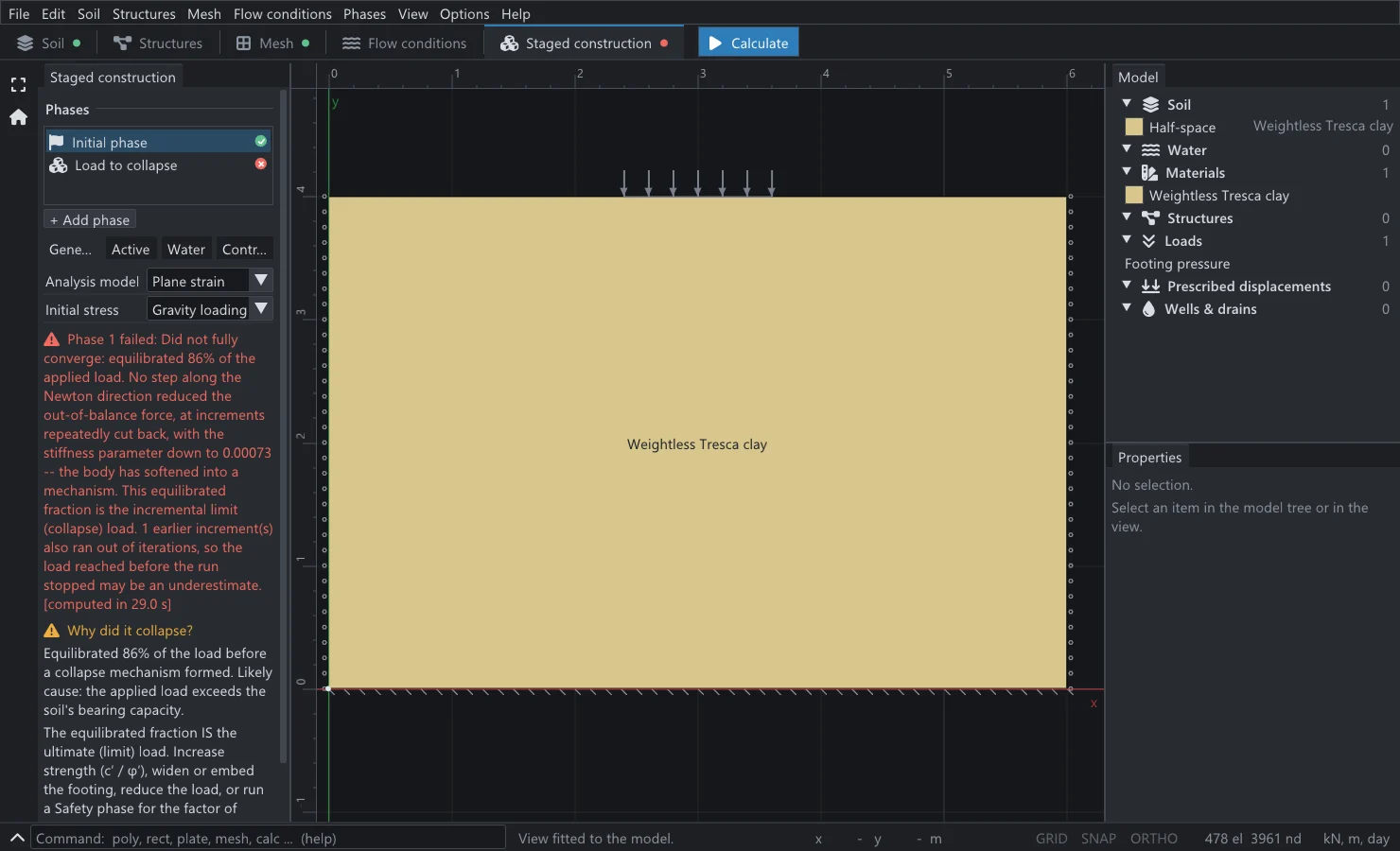
- An honest ending. When a load cannot be equilibrated the run reports the fraction it did equilibrate, the stiffness parameter at that point, and whether the stop was a mechanism or a stalled search — because only one of those is a bearing capacity.
Verified
The numbers, with their sources.
Each row is a case in the generated verification matrix, asserted by an automated test on every build of release 0.9.0.
| Benchmark | Reference | KATAI 2D | Case |
|---|---|---|---|
| Strip footing on a weightless cohesive half-space, loaded past collapse — Nc | Prandtl (1921): 2 + π = 5.142 | +0.6% | KV-FND-010 |
| Smooth rigid circular footing, axisymmetric — limit pressure | Cox (1962) slip-line solution, 225.6 kPa | 233.9 kPa · +3.7% | KV-FND-013 |
| Strip footing on clay with strength increasing with depth, c = 1 + 2z | Davis & Booker (1973), 7.80 kPa | 7.91 kPa · +1.4% | KV-FND-014 |
| Smooth rigid strip footing on elastic soil — force at 10 mm settlement | Giroud (1972), 15.15 kN/m | 15.32 kN/m · +1.1% | KV-FND-012 |
| Strip load on incompressible Gibson soil (E = 299 z) — settlement | Gibson (1967); finite-layer value 0.047 m | 0.0454 m · −3.4% | KV-FND-011 |
| Uniform strip load — vertical stress at depth | integrated Boussinesq closed form | +0.9% … +1.4% | KV-FND-008 |
| Line load — vertical stress at depth, tri15 | Flamant (1892) | +0.0% … +1.3% | KV-FND-009 |
| Pile row loaded far above its capacity — axial force at the head | shaft + base capacity, closed form | 600.0000 kN/m · −0.00% | KV-STR-004 |
Stated as the record states it: the circular footing over-predicts by +3.7% on the file’s 0.25 m mesh and by about +9% on a 0.5 m mesh with two elements across the radius. Displacement finite elements approach a collapse load from above, and a coarse mesh under the footing edge is where that bias lives. All eight cases run from .k2d files checked into the repository.
The complete record, with every tolerance band, is on the verification page.
Stated limits
What this analysis does not do, in the same place as what it does. A limit you know about is an engineering judgement; one you find out about later is an error.
- Limit loads from displacement finite elements are upper-biased on coarse meshes; refine under the footing edge (the mesher does this automatically near loads and structures).
- A rectangular or square footing is a three-dimensional problem. Plane strain models the strip, axisymmetry the circle; nothing in between.
- For a non-associated material the collapse load depends on the mesh in the same way a strength-reduction factor does.
Questions
How accurate is a finite element bearing capacity?
On problems with exact solutions KATAI 2D is within +0.6% (Prandtl strip footing), +1.4% (Davis & Booker, strength increasing with depth) and +3.7% (Cox circular footing) on the meshes of the checked-in files. The error is one-signed — the method approaches the collapse load from above — and it shrinks with refinement under the footing edge.
Can it model a circular footing or a single pile properly?
Yes, in axisymmetry: the model is the r–z half-section, the hoop strain and stress are carried, and integration is weighted by the radius. This is a different formulation from plane strain, not a scaled strip.
How do I model a rigid footing?
Prescribe the settlement along the footing width instead of applying a pressure, and read the footing force from the reactions. That is how the Giroud and Cox benchmarks are run.
Related
Other analyses on the same engine.
Consolidation & embankments
Staged fill on soft ground: excess pore pressure, settlement and creep through time.
|ΔU| ≤ 0.0061 vs Terzaghi Read more → ApplicationExcavations & retaining walls
Walls, prestressed anchors, struts and interfaces through a real construction sequence.
beam moments +0.00% vs theory Read more → ApplicationRock & tunnels (Hoek–Brown)
The generalised Hoek–Brown criterion, verified around a deep tunnel.
tunnel σ_r: 0.59% / 0.72% Read more →Install it, run a published benchmark, check the number.
KATAI 2D is free under Apache‑2.0, installs in one line and ships the input files of the benchmarks it is verified against. The fastest way to judge it is to rerun one.