Desktop application · in development

The same verified engine, with a drawing board on top.

The open-source release of KATAI 2D is a command line and a Python package. On top of the same engine, a desktop application is being built for the engineer who would rather draw a section than script it: geometry, structures, mesh, construction stages, results and reports in one window. It is a separate track and not part of the open-source release. Everything below is a real capture from the development build — nothing is a mock-up.
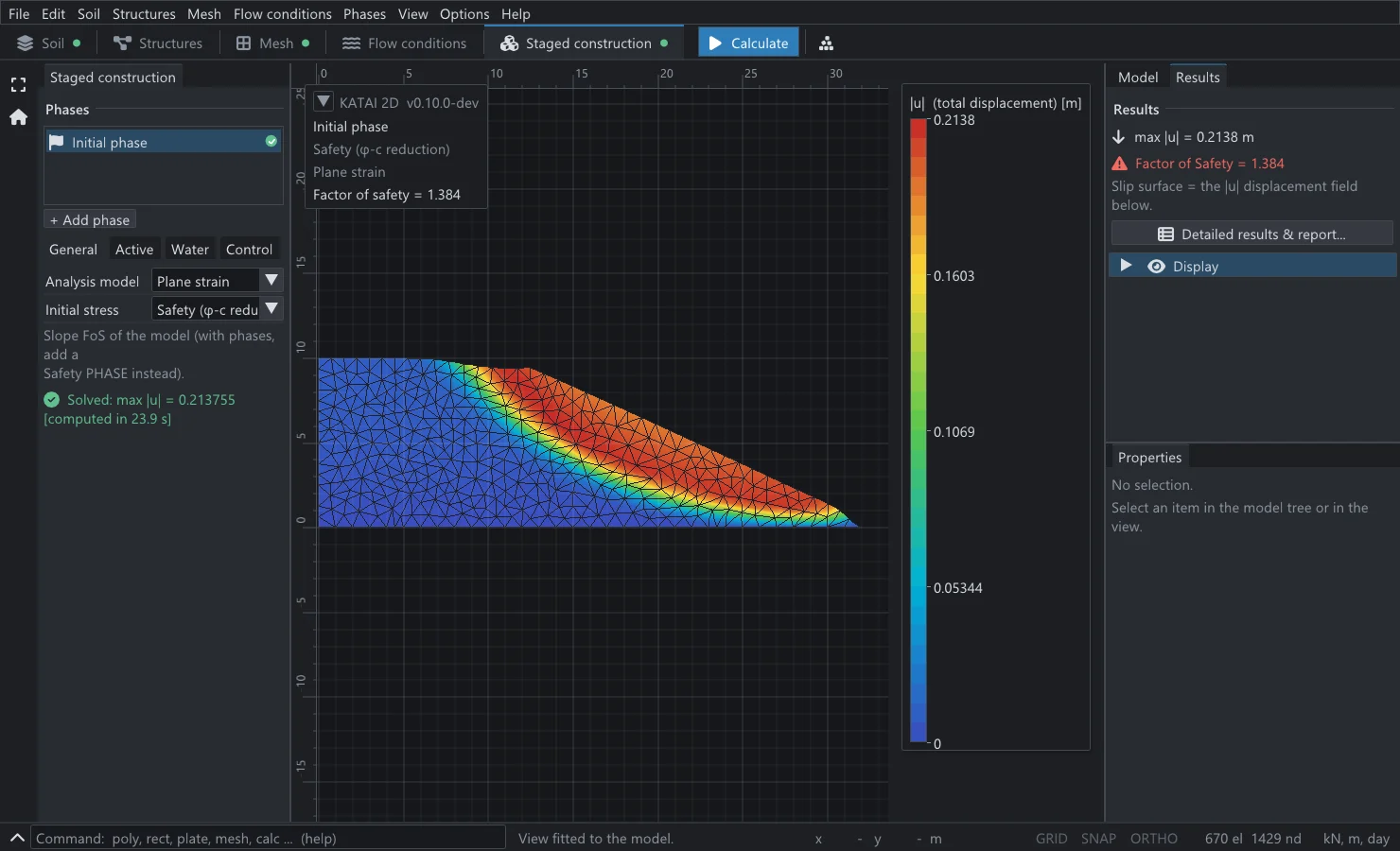
KATAI 2D desktop application showing a slope stability result: factor of safety 1.384 by phi-c reduction on the Griffiths and Lane Example 1 slope, total displacement contours from 0 to 0.2138 metres marking a curved slip surface on a mesh of 670 elements, with phases panel on the left and results panel on the right.
Factor of safety 1.384. The Griffiths & Lane (1999) Example 1 slope; the Bishop & Morgenstern chart value is 1.380. The contours are the displacement field at failure — the slip mechanism, found rather than assumed.

Five modes, in the order of the work

The window follows the sequence of an analysis, left to right: Soil, Structures, Mesh, Flow conditions, Staged construction — and one Calculate button. Each tab carries the standing of its step, so you can see at a glance whether the mesh is older than the geometry or the results are older than the model.

  • Draw with the mouse on a snapping grid, or type coordinates into a command line: poly, rect, plate, absolute, relative and polar points.
  • Import geometry from DXF.
  • Material sets for all seven constitutive models, with drainage type and permeability.
  • Light and dark themes; reports in English and Turkish.

A tied-back excavation, start to finish

Structures, mesh, seven construction phases, results.
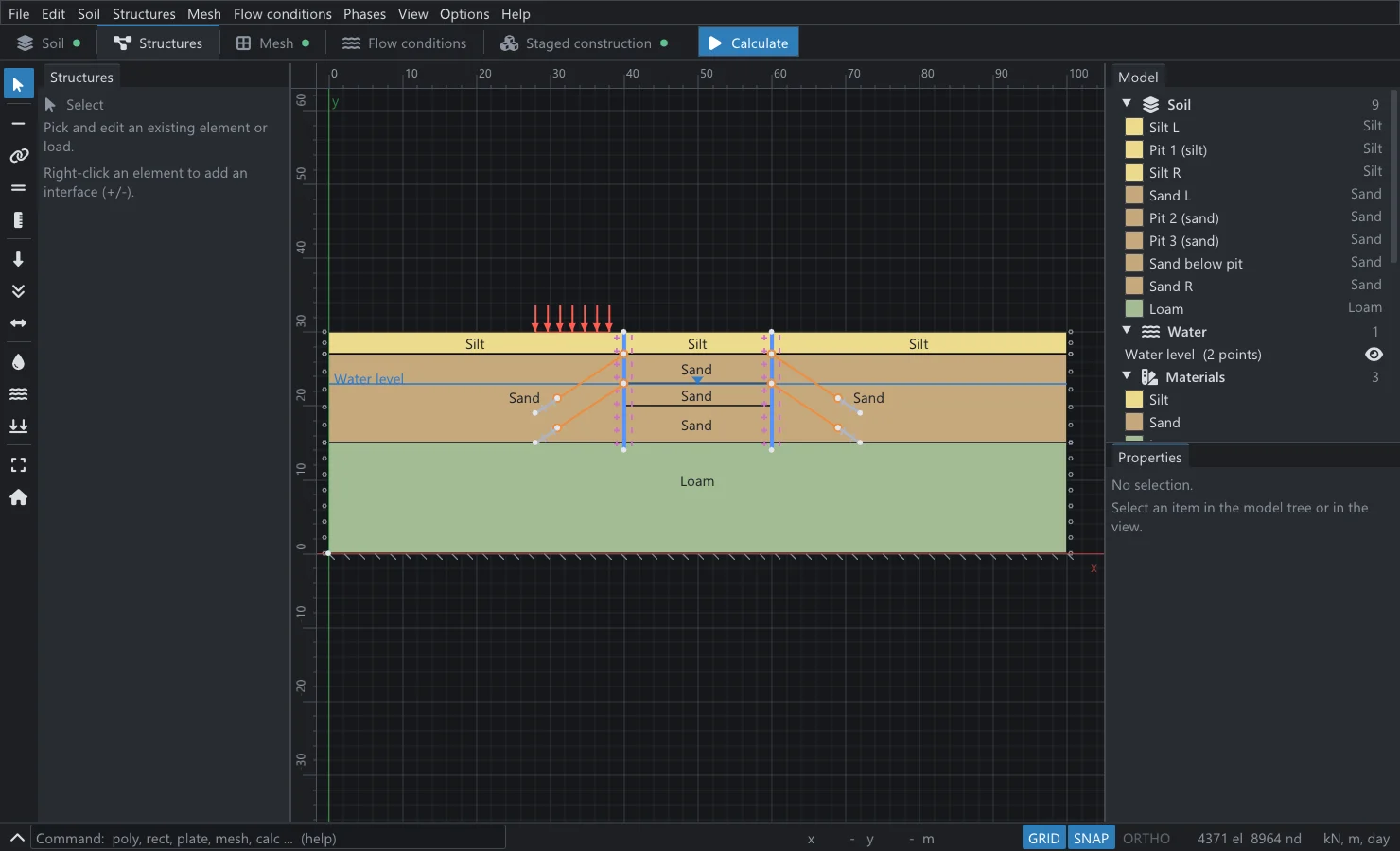
KATAI 2D structures mode: an excavation in silt over sand over loam, supported by two retaining walls with interfaces and four inclined anchors, with a surcharge beside the pit, the groundwater level, a model tree and a toolbar of structural element tools.
Structures. Two walls with interfaces on both faces, two anchor levels a side, a surcharge and the water level, over silt, sand and loam.
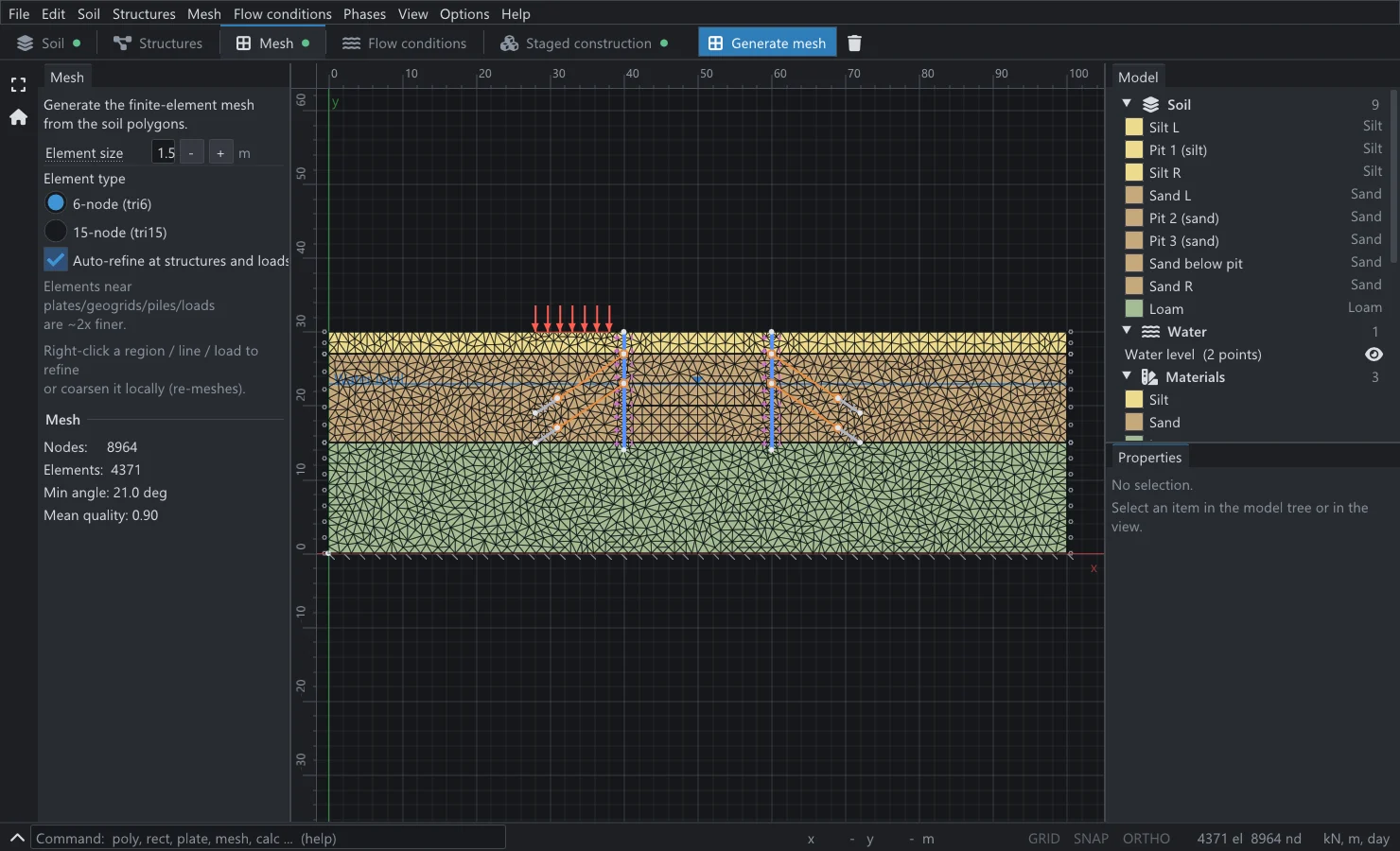
KATAI 2D mesh mode: the same excavation meshed with 4371 six-node triangles and 8964 nodes, refined around the walls and anchors, with element size, element type, automatic refinement and mesh quality statistics in the side panel.
Mesh. One click: 4371 six-node elements, refined near structures and loads. Minimum angle 21.0°, mean quality 0.90, both reported.
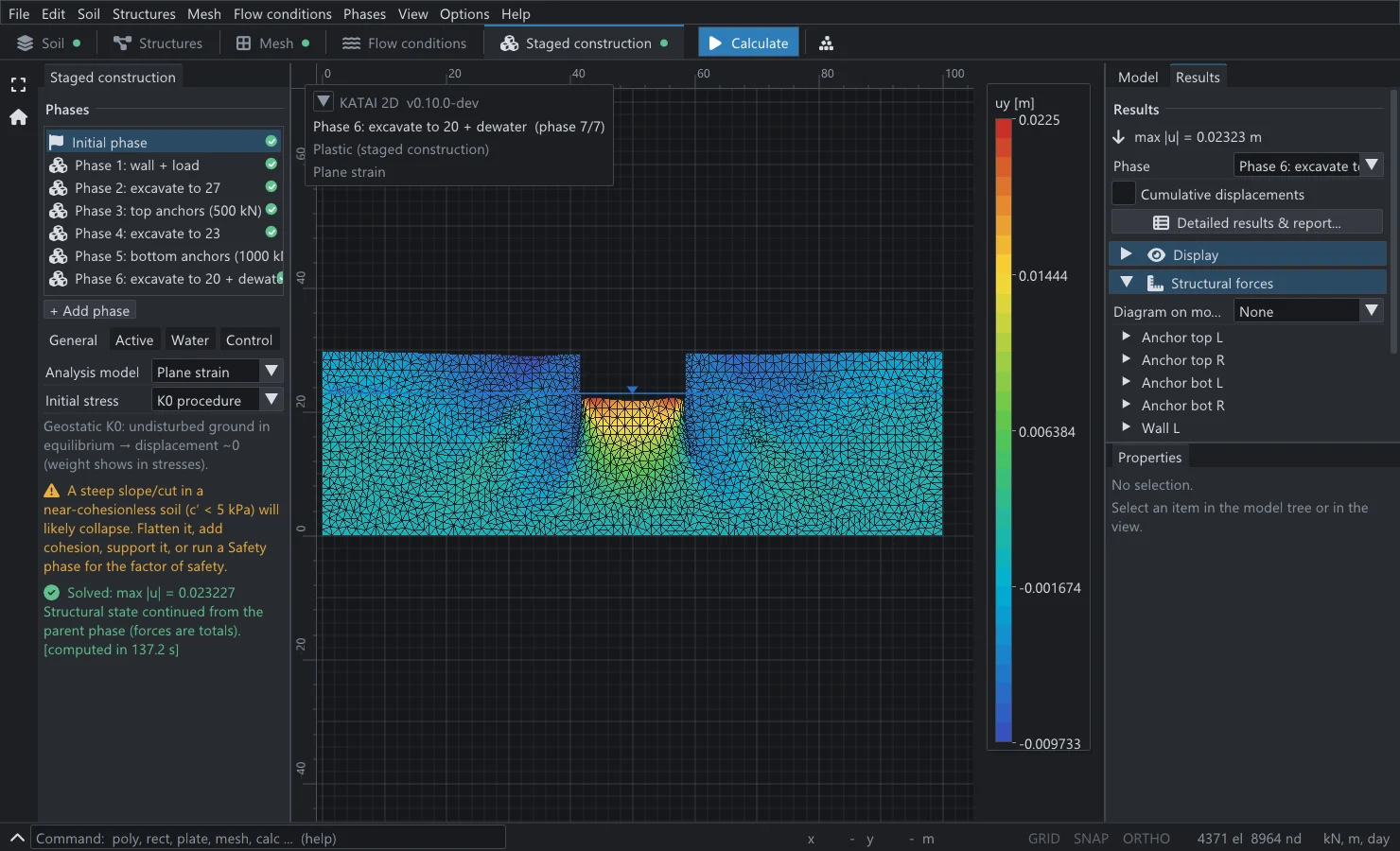
KATAI 2D staged construction mode with results: seven phases from wall installation through excavation, anchor prestressing and dewatering, all marked calculated; vertical displacement contours showing heave of the pit floor of 22.5 millimetres and settlement behind the walls; a list of anchors and walls whose force diagrams can be displayed.
Results. Wall and load, dig to 27, top anchors at 500 kN, dig to 23, bottom anchors at 1000 kN, dig to 20 with dewatering. Pit-floor heave 22.5 mm; force diagrams for every anchor and wall.
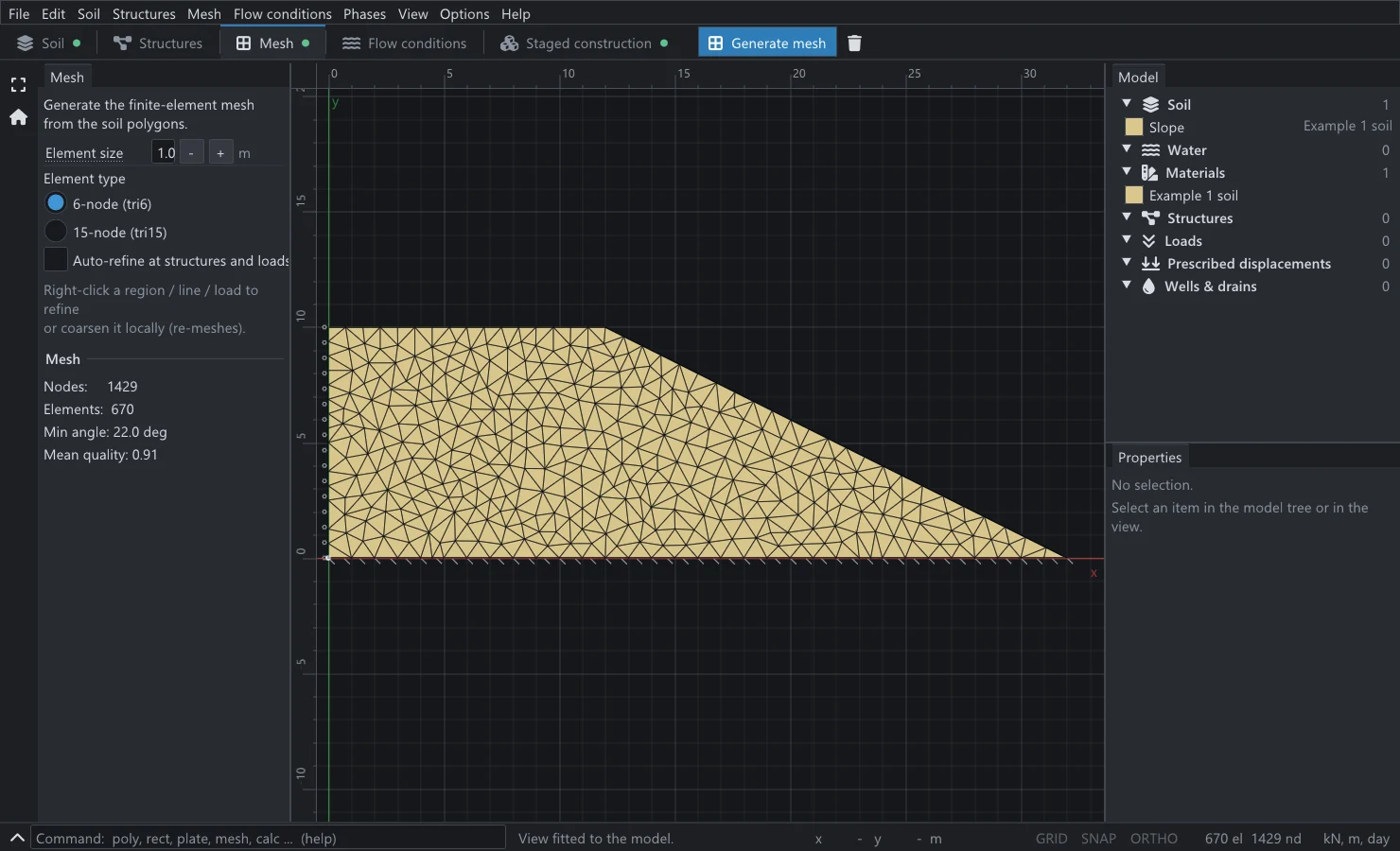
KATAI 2D mesh mode showing the Griffiths and Lane slope meshed with triangular finite elements, with mesh statistics in the side panel.
Every model the same way. The slope of the first screenshot, at the meshing step.

When a model fails, it tells you what that means

A load that the ground cannot carry is not an error message to be dismissed. In the capture on the right a strip footing has been loaded past its bearing capacity. The phase is marked failed, and the panel explains: 86% of the applied load was equilibrated before a collapse mechanism formed; the stiffness parameter fell to 0.00073; that equilibrated fraction is the limit load; and because an earlier increment ran out of iterations, the figure may be an underestimate.

It then says what to do about it — increase strength, widen or embed the footing, reduce the load, or run a Safety phase. The same information is in the engine’s results file and in the Python API; the desktop application only makes it hard to overlook.
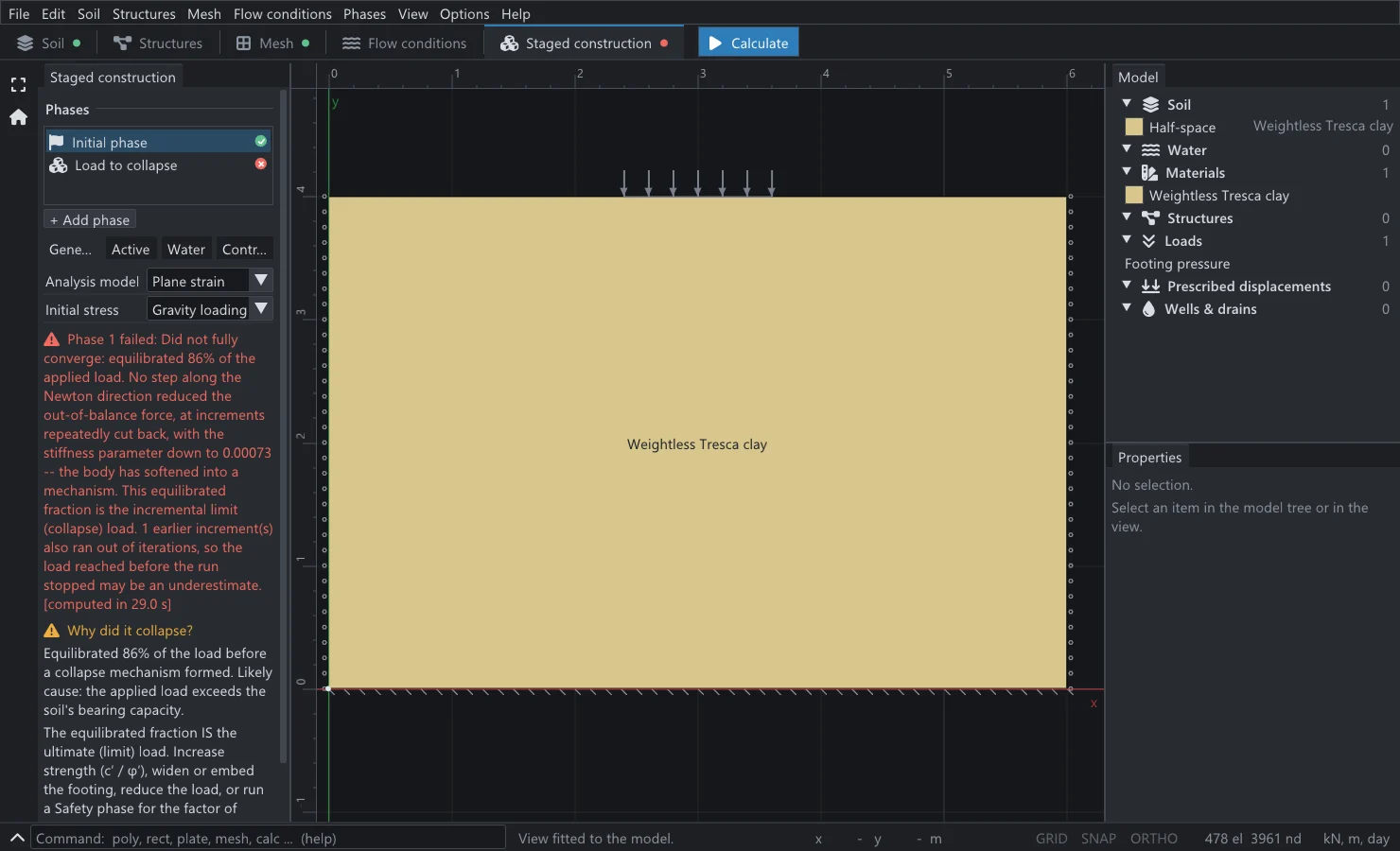
KATAI 2D after a strip footing on weightless Tresca clay was loaded to collapse: the load phase is marked failed and a message states that 86 percent of the applied load was equilibrated, the stiffness parameter fell to 0.00073, the body has softened into a mechanism, and the equilibrated fraction is the incremental limit load.
Collapse, diagnosed. The Prandtl benchmark taken past failure: what was reached, why it stopped, and how to read the number.

Preview list

Be told when the preview opens.

Leave your email to be invited to the desktop preview and to hear about new releases of the engine. No payment, no commitment, and the engine is free to use today regardless.