Application · Slope stability
Slope stability by strength reduction, with the mesh stated beside the number.
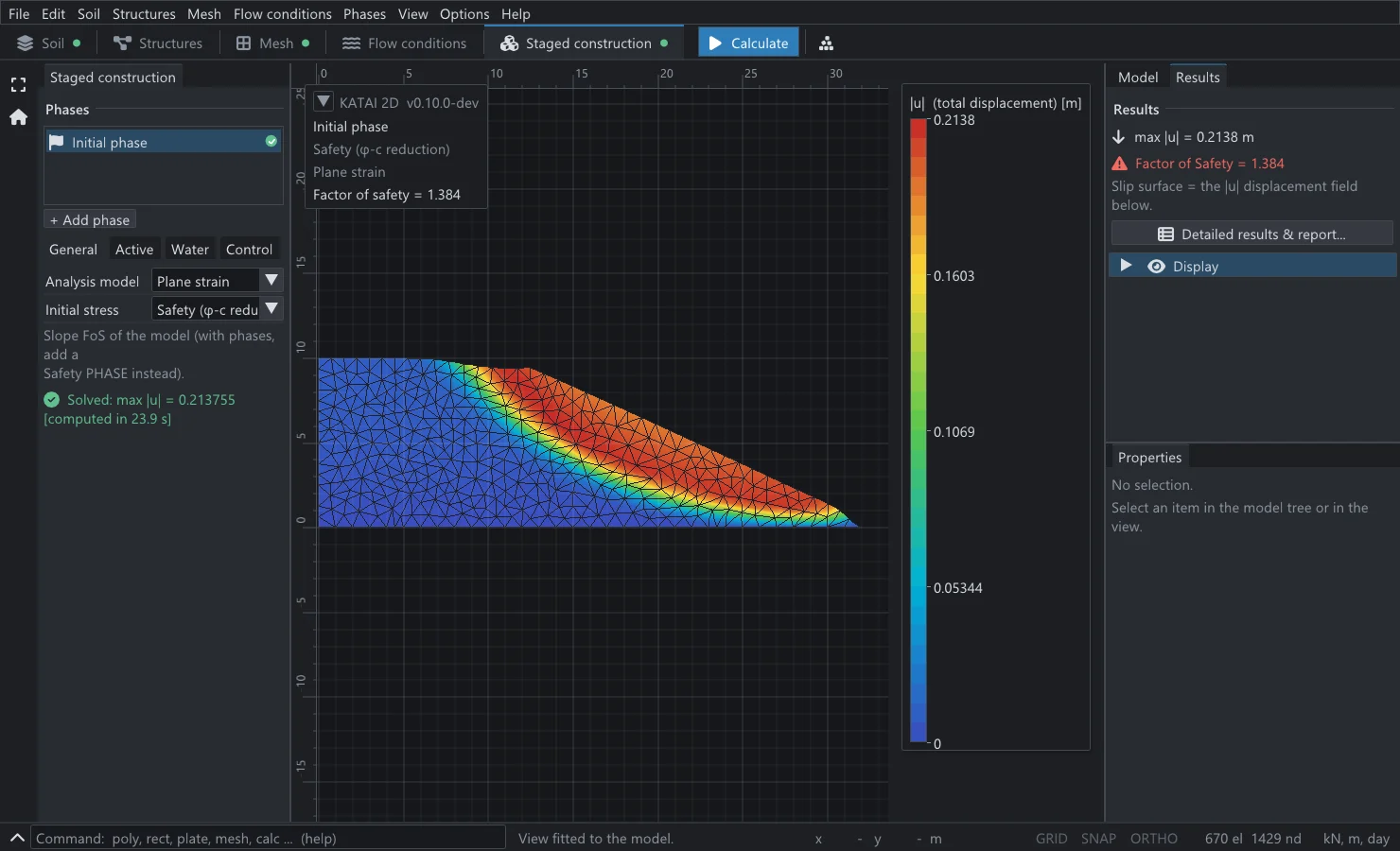
KATAI 2D computes the factor of safety of a slope, an embankment or an excavated face by the finite element strength reduction method. No slip surface is assumed: the mechanism is whatever the soil finds. On the Griffiths & Lane (1999) reference slope it returns 1.384 against a charted 1.380 — and it tells you, on the same line, how far that number moves when the mesh is refined.
The engineering problem
Limit-equilibrium methods divide a slope into slices and search over assumed slip surfaces. They are fast and well understood, and they need the analyst to decide in advance what shape failure will take, how the slices interact, and where the surface may pass. On a homogeneous slope those decisions are easy. Next to a retaining wall, across a weak layer, under a staged embankment on soft clay, or with a pore-pressure field that came out of a seepage or consolidation analysis, they are the part of the answer nobody can check.
The strength reduction method removes them. The same finite element model that gave the deformations is solved again with the shear strength divided by a trial factor F; F is raised until equilibrium can no longer be found. The factor at which that happens is the factor of safety, and the displacement field at that moment is the failure mechanism.
The formulation
The full statement of what is solved, element by element and model by model, is on the theory and constitutive models pages.
What KATAI 2D does
- Safety as an initial procedure or as a phase. Run it on the gravity state of a model (
initial(procedure="safety")), or after any staged phase (prj.phases.safety()) to get the factor of safety of the construction stage you have just built — after an excavation, at the end of a fill, after a drawdown. - The mechanism comes out with the number. The displacement field at failure is the slip mechanism; the desktop application draws it, the Python API returns it as an array.
- Pore pressures from the same model. A phreatic line, a steady or transient seepage solution, or the excess pore pressures left by a consolidation phase are the water the strength reduction sees. Nothing is transferred between programs.
- Structures stay in the model. Walls, anchors, geogrids and interfaces remain active during the reduction, so a reinforced slope is analysed as the reinforced slope.
- A factor of safety that does not depend on the stopping tolerance. On the verification mesh the factor is identical to the last printed digit — 1.421021 — for a tolerated force residual of 10−3, 10−4, 10−6 and 10−8 (case KV-NUM-007).
Verified
The numbers, with their sources.
Each row is a case in the generated verification matrix, asserted by an automated test on every build of release 0.9.0.
| Benchmark | Reference | KATAI 2D | Case |
|---|---|---|---|
| Griffiths & Lane (1999) Example 1 — homogeneous 2:1 slope, c′/γH = 0.05, φ′ = 20° | Bishop & Morgenstern (1960) charts 1.380; their own FE value 1.4 | FoS 1.384 · +0.3% | KV-SLP-002 |
| Griffiths & Lane (1999) slope with a published FoS near unity | published ≈ 0.99 (Bishop 0.988, Spencer 0.987) | FoS 1.010 · +2.1% | KV-SLP-001 |
| The same Example 1 on a nested mesh family (142 → 568 → 2272 elements) | grid-convergence procedure of Celik et al. (2008) | 1.4210 → 1.3867 → 1.3645 · band ±3.7% | KV-SLP-003 |
| Factor of safety against the tolerated force residual, 10−3 … 10−8 | independence of the stopping rule | 1.421021, bit-identical | KV-NUM-007 |
The third row is the one most programs do not print. With a non-associated flow rule (ψ < φ) the shear band narrows with the elements, so the strength-reduction factor of safety falls as the mesh is refined — 4.0% across a fourfold refinement on this slope. KATAI 2D raises diagnostic K2D-A005 on every such run, stating that the factor should be quoted with the mesh it was computed on and confirmed by a refinement study.
The complete record, with every tolerance band, is on the verification page.
In Python
The analysis as a script.
import katai

# Units everywhere: kN, m, day.
prj = katai.Project("Griffiths & Lane slope", mesh_size=3.0, auto_refine=False)

soil = prj.materials.mohr_coulomb("Clayey sand", E=1.0e5, nu=0.3,
                                  c=3.0, phi=19.6, gamma=20.2)

# Geometry drawn counter-clockwise, one fixity name per edge.
prj.geometry.polygon(
    [(20, 20), (70, 20), (70, 35), (50, 35), (30, 25), (20, 25)],
    material=soil,
    fix=["full", "horizontal", "free", "free", "free", "horizontal"])

prj.initial(procedure="safety")     # phi-c reduction of the gravity state

job = prj.run()
print(f"FoS = {job.results()[-1].fos:.3f}")   # 1.010; published ~0.99
Fourteen lines from an empty file to a factor of safety. The same case is checked in as kv-slp-001-griffiths-lane-slope.k2d and solves from the command line in about eight seconds.
The whole scripting surface is documented on the Python API page.
Stated limits
What this analysis does not do, in the same place as what it does. A limit you know about is an engineering judgement; one you find out about later is an error.
- With a non-associated flow rule the factor of safety is mesh-dependent. This is a property of the method, not of the program; it is measured (KV-SLP-003) and reported with every run (K2D-A005).
- A Safety phase is refused for Hoek–Brown rock in this release: reducing a curved envelope by a single factor is not the same operation as reducing c and tan φ, and the engine does not pretend it is.
- Two-dimensional plane strain. End effects of a slide of finite width are outside the model.
Questions
Is a finite element factor of safety comparable to a Bishop or Spencer factor?
On a homogeneous slope, yes, within a few percent — KATAI 2D gives 1.384 on a slope whose Bishop & Morgenstern chart value is 1.380, and 1.010 where Bishop gives 0.988 and Spencer 0.987. The two methods answer the same question by different routes; where they differ noticeably, the finite element mechanism is usually one the slice method was not asked to search.
Why does the factor of safety change when I refine the mesh?
With a dilatancy angle smaller than the friction angle the failure localises into a shear band whose width is set by the element size, so the computed collapse load falls slowly with refinement. On the verification slope the factor moves from 1.4210 to 1.3645 over a fourfold refinement. KATAI 2D reports this with diagnostic K2D-A005 instead of hiding it; quote the factor with its mesh, or run a refinement study.
Can I get the factor of safety of an intermediate construction stage?
Yes. A Safety phase can follow any staged phase, so each stage of an excavation or an embankment can have its own factor of safety.
Related
Other analyses on the same engine.
Consolidation & embankments
Staged fill on soft ground: excess pore pressure, settlement and creep through time.
|ΔU| ≤ 0.0061 vs Terzaghi Read more → ApplicationExcavations & retaining walls
Walls, prestressed anchors, struts and interfaces through a real construction sequence.
beam moments +0.00% vs theory Read more → ApplicationGroundwater flow & seepage
Confined and free-surface flow, wells, drains and barriers — coupled to the soil.
dam discharge +1.02% Read more →Install it, run a published benchmark, check the number.
KATAI 2D is free under Apache‑2.0, installs in one line and ships the input files of the benchmarks it is verified against. The fastest way to judge it is to rerun one.